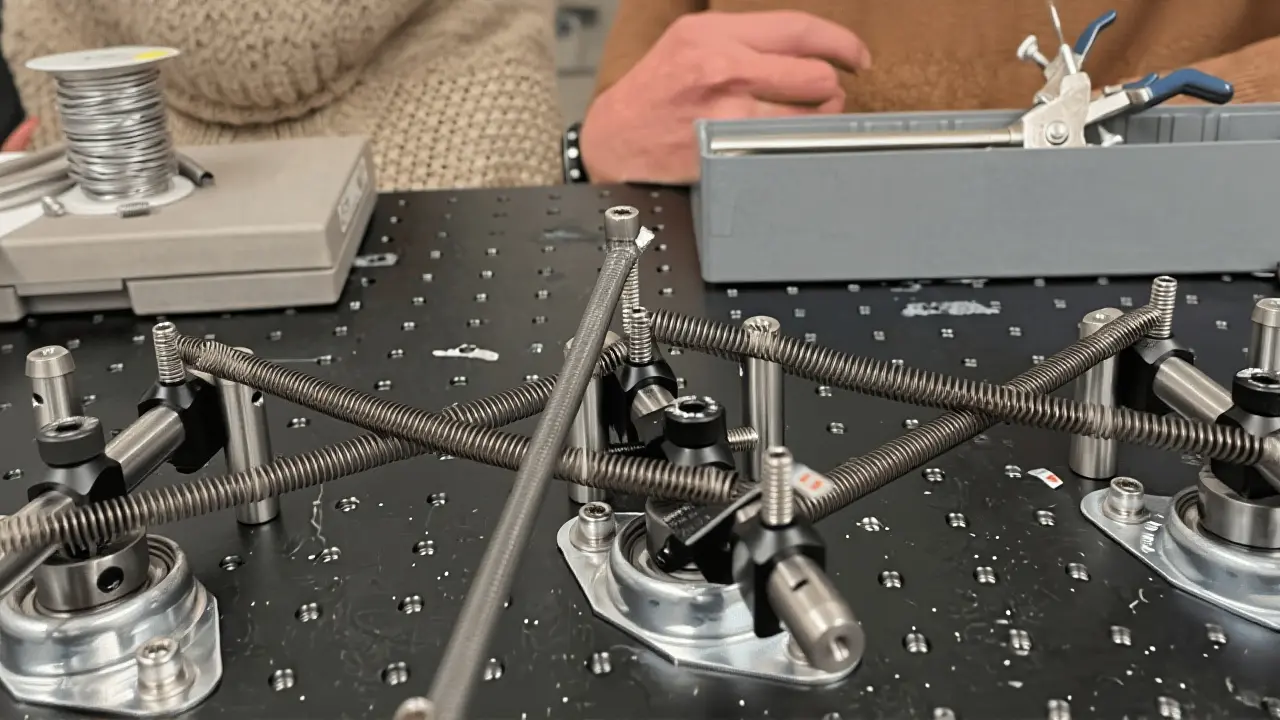
Forget silicon wafers and lithium batteries. Paulsen and a team of researchers have just proven that you don't need a single spark of electricity to perform calculations. By using nothing more than steel springs and rigid bars, the team developed a mechanical computer that processes information through physical force, effectively stripping away the need for a power grid or a computer chip.
The breakthrough, detailed in a recent publication by Nature Communications, was a collaborative effort between St. Olaf College and Syracuse University. At its core, the device is an elegant piece of engineering: a steel bar that pivots with a stretching spring. Give it a small shove, and the setup flips into a new state, staying there until the next push arrives. It's essentially a physical version of a digital switch.
The physics of 'memory' without chips
Here's the thing: for a computer to actually *compute*, it needs to remember what happened a moment ago. The researchers achieved this using a property called hysteresis. In simple terms, the system's current state depends on its history. If you push the bar past a certain threshold, it flips; if you move it back past another threshold, it flips back. This allows a single mechanical unit to act as a memory cell.
But a single switch isn't a computer. To make it smarter, the team linked these units together using coupling springs. Some arrangements forced neighboring bars to mimic each other, while others pushed them toward opposite states. By tweaking where these springs attached, the researchers could "tune" the influence one unit had over another, effectively building a mechanical circuit board.
- Core Materials: Steel springs, steel rods, and rigid bars.
- Power Source: Manual physical force (pushing/pulling).
- Core Principle: Hysteresis (state-dependency based on history).
- Capabilities: Counting, parity checking (odd/even), and force memory.
Three prototypes proving the concept
To show this wasn't just a theoretical exercise, the team built three distinct machines. The first is a cycle counter. By creating a chain of coupled units, they established a "moving boundary" between two patterns. Every half-cycle of motion pushes that boundary one step further. According to the data, a chain with 2n units can record up to n cycles. It's a physical tally mark system.
The second version is a bit more abstract: it can distinguish whether it has been pushed an odd or even number of times. The third prototype serves as a force sensor, remembering whether a medium or large amount of pressure was applied to the system. While these tasks seem primitive compared to a smartphone, they represent a fundamental shift in how we think about information processing.
"We now have a rational way of building these machines that can perform simple computations without a computer chip or a power source," Paulsen noted. The goal isn't to replace your laptop, but to create a new class of "smart materials."
Why a non-electric computer actually matters
You might be wondering why we'd go backward to springs and bars. Turns out, there are places where electricity is a liability. Think about the inside of a nuclear reactor, the depths of a corrosive chemical vat, or the extreme temperature swings of deep space. In these environments, standard semiconductors often fry or dissolve. A steel-and-spring computer, however, just keeps clicking.
Beyond hazardous environments, the implications for robotics are fascinating. The researchers envision materials that can sense their surroundings, make a decision, and respond—all without a central processor. This could lead to artificial limbs that react more naturally to pressure or "tactile rooms" that physically morph based on environmental conditions.

Funding and the road ahead
This project wasn't a solo effort. It was backed by a network of academic and governmental support, including the Aspen Center for Physics and the National Science Foundation via grant PHY-2210452. The collaboration between the two universities provided the cross-disciplinary expertise needed to marry mechanical geometry with computational logic.
The next step is scaling. Moving from three basic functions to a more complex logic system will require more intricate spring configurations. The details on how they plan to integrate these into "smart materials" are still a bit hazy, but the proof of concept is now firmly established. The era of the non-electronic computer might be old, but it's getting a very modern second wind.
Frequently Asked Questions
Can this mechanical computer run software like Windows or macOS?
No, not even close. These machines are designed for basic computations—counting, parity checking, and force memory. They lack the billions of transistors and the clock speed required to run modern operating systems, as they rely on physical movement rather than electron flow.
What exactly is "hysteresis" in this context?
In this mechanical system, hysteresis means the bar's current position depends on where it was previously. It doesn't just snap back immediately; it stays in a state until a specific threshold of force is reached, allowing the device to "remember" a previous input.
Where would these computers actually be used?
They are ideal for "extreme environments" where electronics fail, such as areas with high radiation, extreme heat, or corrosive chemicals. They are also being eyed for use in smart materials and advanced prosthetics that need to react to physical stimuli without heavy wiring.
Who funded the research for this project?
The research was a joint effort funded by Syracuse University, St. Olaf College, the Aspen Center for Physics, and the National Science Foundation (specifically through grant PHY-2210452).
Gary Clement
April 18, 2026 AT 06:38really cool application of mechanical hysteresis it basically turns physical energy into a state machine which is super useful for high radiation zones where electrons just get scrambled
Antony Bachtiar
April 18, 2026 AT 21:46wow we spent billions on silicon just to go back to springs lol this is basically a glorified abacus with more steps
Aaron X
April 19, 2026 AT 20:23The ontological shift here is the transition from electronic substrates to purely kinematic logic. By leveraging the non-linear response of these bistable mechanisms, they've essentially implemented a form of physical computation that bypasses the von Neumann bottleneck through structural topology rather than temporal sequencing. It's an elegant manifestation of emergent complexity within a deterministic mechanical framework.
Shelley Brinkley
April 20, 2026 AT 09:54waste of nsf money honestly lol just build a better lead shield if u want it in a reactor
Mason Interactive
April 20, 2026 AT 15:31This is honestly wild. Imagine a future where your prosthetic arm has its own little mechanical brain to handle pressure reflex without needing a battery pack. Total game changer for accessibility tech.
Beth Elwood
April 22, 2026 AT 07:45The potential for soft robotics here is massive! 🤖 Integrating these as 'smart skins' could let machines feel and react to their environment in real-time without any lag from a central CPU. Super exciting stuff 🚀✨
Josh Raine
April 23, 2026 AT 09:58Why do we always assume 'primitive' means 'useless'? 🙄 The hubris of thinking electricity is the only way to process info is exactly why we hit walls in other fields. This is a masterclass in first-principles thinking!
Dianna Knight
April 25, 2026 AT 05:38I totally agree with the sentiment here! 😊 The use of mechanical coupling to achieve parity checking is such a clever way to implement boolean logic without the need for semiconductor fabrication. It's like a beautiful dance of physics and math wrapped in steel springs!
nikolai kingsley
April 26, 2026 AT 06:52absolutly ridiculuous to think this is an inovation when old clockworks did this ages ago ppl just love to pretend they found somethin new for a grant
Anirban Das
April 27, 2026 AT 21:40meh just a fancy toy 🥱
Mayank Rehani
April 28, 2026 AT 12:50The implementation of a moving boundary for the cycle counter is quite an interesting approach to state-space representation. Integrating these mechanical units into a larger distributed system could lead to very robust asynchronous logic gates, provided the mechanical tolerances are managed properly.
Anamika Goyal
April 30, 2026 AT 11:55I wonder how they handle the wear and tear on the springs over time. If this is meant for extreme environments, the material fatigue must be a huge factor, but it's so inspiring to see researchers stepping outside the digital box!
Angie Khupe
May 2, 2026 AT 10:37It's just so neat to think about things working in a different way :) maybe we can find a middle ground where these and electronics work together!
Mel Alm
May 3, 2026 AT 13:44honestly it sounds like something out of a steampunk novel but way more usefull for actual science stuff
Alex Green international
May 4, 2026 AT 06:45It is indeed a commendable achievement in the field of material science and mechanical engineering. One must admire the patience required to calibrate such intricate systems to ensure reliable computation without the aid of electronic monitoring